At MindBerry, we have always believed that meaningful change in mental health comes from consistent, evidence-based practices embedded in daily life. We created the MindBerry Resilience App to hold this vision – it is a structured digital programme designed by psychologists, grounded in validated research, and built to translate scientific knowledge about resilience into something everyone can use.
Before its official release, we are doing something we believe every digital mental health tool should do: testing it rigorously.
What is the study about?
The study is exploring a simple but important question: can daily wellbeing activities, done consistently over time, improve how people feel mentally, physically, and in their everyday functioning?
The activities in the app are drawn from six evidence-based domains: body awareness, time perspective, coping strategies, anxiety regulation, burnout prevention, and self-care – and the library contains 60 science-backed tools in total. Each one has been designed by psychologists and grounded in peer-reviewed research.
The study is led by Olga Klamut – psychologist, research coordinator at MindBerry, and a doctoral candidate at the First Faculty of Medicine at Charles University in Prague, one of the oldest and most respected medical universities in Europe. It is a collaboration that moves in both directions at once: not just applying research to practice, but testing practice through research.
How does the app work?
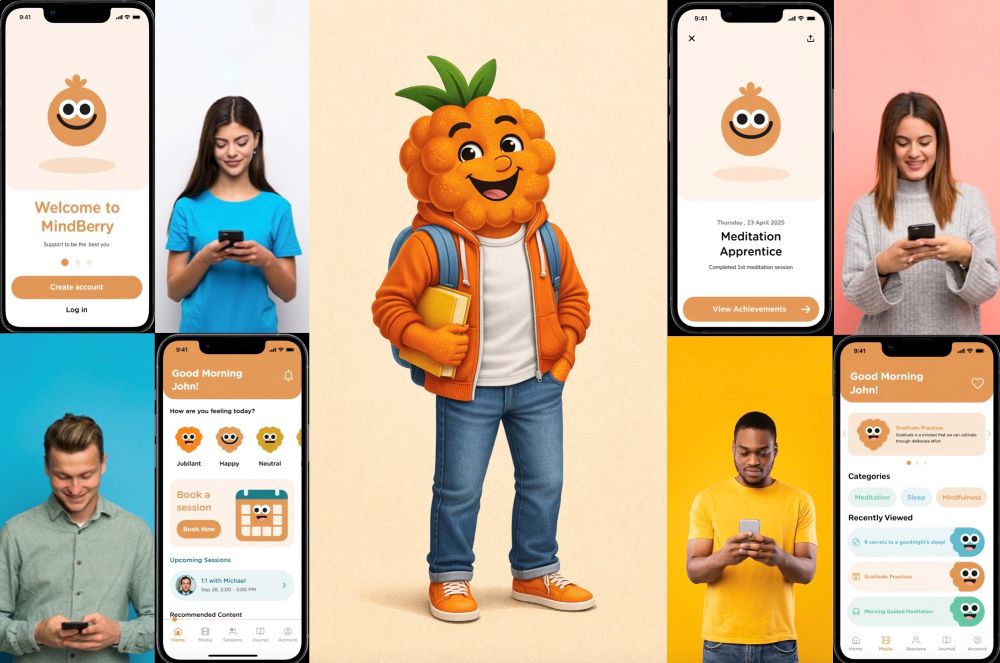
Participants begin with a short resilience assessment in the form of a quiz. Based on their results, they receive six daily activities – brief, practical, and designed to integrate into an existing routine and busy schedule. After completing a full cycle, users take the quiz again and receive a new set of activities.
The design rests on a well-supported principle in behavioural psychology: that sustained change depends less on intensity and more on repetition, timing, and personal relevance.
Why does this study matter?
Digital mental health tools are among the fastest-growing areas of the global wellness industry. Yet the vast majority enter the market without independent clinical evidence of their effectiveness. This creates a significant gap between what is offered and what is actually known.
By embedding a rigorous research study into the app’s development phase – before launch, not after – MindBerry is taking a different approach. The goal is not to claim effectiveness, but to measure it. To generate real data, under real conditions, with real people.
Can I participate?
The study is currently open to participants. It involves using the app over a 28-day period and completing two short questionnaires – one at the beginning and one at the end. Participants are assigned to a start date upon signing up. Participation is entirely anonymous, voluntary, and free.
This is an opportunity both to engage with a psychologist-designed resilience programme and to contribute to clinical research that is working to raise the standard of evidence in digital mental health.
For your participation
As a thank you for being part of this research, MindBerry is giving back in two ways. Every participant who completes the full 28 days will generate a donation to Heads Together, a mental health charity dedicated to changing the conversation around mental health. Additionally, five participants will be selected at random at the end of the study to win a MindBerry voucher, each worth a 30-minute session with one of our professionals, valid until the end of the year. A small way of giving back to the people who are helping us build something better.
CLICK HERE to sign up & take the first questionnaire
More information is available at the dedicated MINDBERRY STUDY WEBSITE
If you have any questions or inquiries, you can contact us at mindberryresearch@proton.me
A note from the research lead
“Resilience is not something you have or don’t have. It is something you practice. What I have seen both in research and in clinical work is that the people who function well under pressure are not the ones who have avoided difficulty – they are the ones who have built small, consistent habits of self-regulation. This app is designed to make that process accessible. The study is there to find out whether it works.”
— Olga Klamut, PhD Candidate, Department of Psychiatry, First Faculty of Medicine, Charles University Prague |
Psychologist and Research Coordinator, MindBerry